


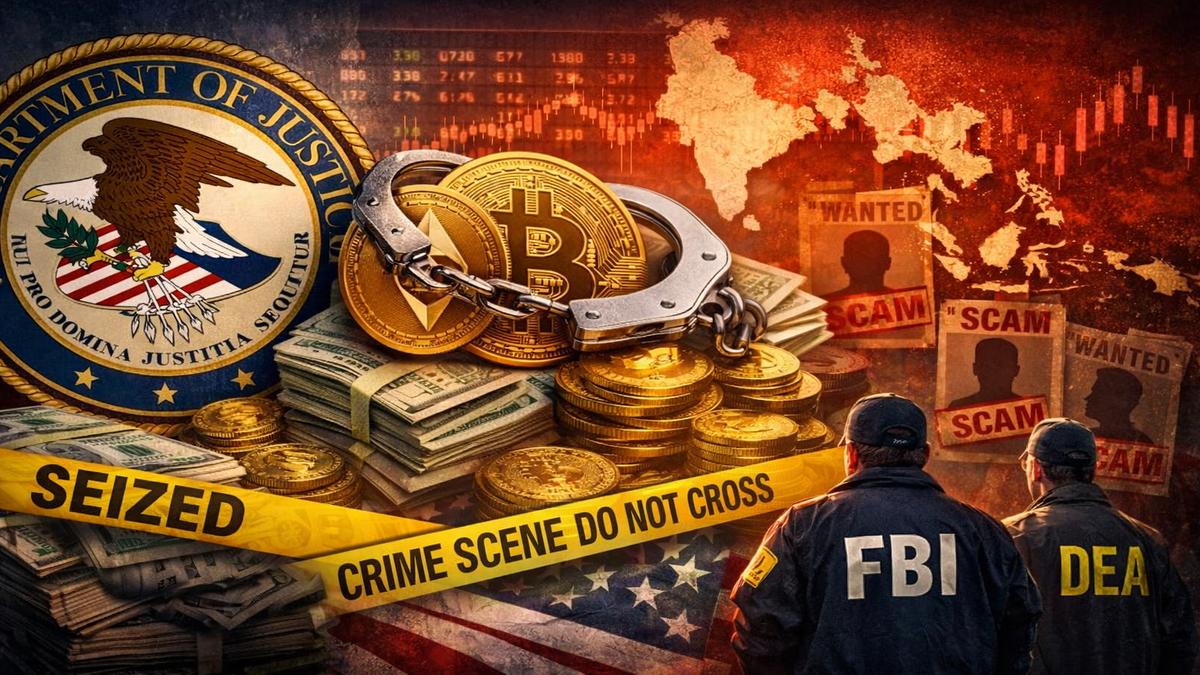
The US gov just made one thing clear: crypto scammers are officially on notice.
Officials at the US Department of Justice announced they have frozen, seized, and initiated forfeiture proceedings on more than $578 million worth of digital assets tied to criminal networks operating across Southeast Asia. The funds were allegedly stolen by Chinese transnational crime groups targeting American victims through fake investment platforms, impersonation schemes, and social media traps.
The seizures were carried out by the District of Columbia’s Scam Center Strike Force — a unit launched in November by US Attorney Jeanine Pirro.
“Seizures of cryptocurrency is one important part of the Scam Center Strike Force’s work,” Pirro said. “Through the legal process, my Office will seek to forfeit these funds and return them to victims to the maximum extent possible.”
Translation: this isn’t about building a government crypto war chest. It’s about clawing money back.
Not for the Strategic Bitcoin Reserve
Pirro’s comments also shut down speculation that the seized crypto would be funneled into the Strategic Bitcoin Reserve established by Donald Trump via executive order in March 2025.
While the US gov is believed to hold massive crypto reserves — data from BitcoinTreasuries.NET estimates authorities may control up to 328,372 Bitcoin through various criminal seizures — there’s been no official confirmation from the White House on the exact size or allocation of that stockpile.
For now, the DOJ says these latest funds are headed back to victims — not into a federal cold wallet.
Crypto Scams Are Exploding
The timing of the crackdown is no accident.
According to blockchain analytics firm Chainalysis, impersonation scams tied to crypto surged by a staggering 1,400% year over year in 2025. Even more alarming? The average amount stolen per incident jumped roughly 600%.
Many of these scams fall under the now-infamous “pig butchering” model — long-con investment schemes where fraudsters build trust over weeks or months before draining victims’ accounts in one brutal sweep.
Some perpetrators have already faced serious consequences. Earlier this month, a U.S. judge sentenced one orchestrator to 20 years in prison for running a $73 million crypto fraud operation that targeted American investors.
The message from regulators is clear: enforcement is no longer reactive — it’s aggressive.
The “10 a.m. Bitcoin Dump” Conspiracy
But while the DOJ was freezing wallets, Crypto Twitter found a new villain.
This week, rumors of a so-called “10 a.m. Bitcoin dump” went viral, with traders accusing quantitative trading giant Jane Street of systematically pushing Bitcoin’s price lower at the U.S. market open.
The theory? That Jane Street was executing daily, programmatic sell-offs to suppress price action.
The claims gained momentum just one day after Jane Street was sued by the court-appointed administrator for Terraform Labs. The lawsuit alleges insider trading tied to transactions that worsened the collapse of Terra’s algorithmic stablecoin ecosystem back in May 2022.
That ecosystem — built around TerraUSD and LUNA — imploded spectacularly, wiping out tens of billions in value and triggering one of crypto’s darkest chapters.
Online commentators quickly connected dots, arguing that Jane Street’s trading activity could be masking a larger short position. Some pointed to the firm’s disclosed holdings in BlackRock’s iShares Bitcoin Trust (IBIT), suggesting derivatives hedges might not show up in public filings.
However, market analysts say the data doesn’t support the conspiracy.
Trading patterns show variability, not consistency. Volume doesn’t indicate a single actor controlling the tape. And most importantly: Bitcoin’s market depth is now large enough that no single firm can single-handedly engineer a prolonged bear market without broader macro forces aligning.
In short, it makes for great X content — but thin evidence.
ETF Demand Roars Back
Ironically, while social media was busy hunting for a “final boss,” institutional demand quietly returned.
After five straight weeks of net negative outflows, U.S.-listed spot Bitcoin ETFs flipped back to positive territory. Funds saw over $1 billion in inflows across three consecutive days, including $254 million on Thursday alone, according to Farside Investors data.
That shift suggests something important: despite lawsuits, rumors, and enforcement crackdowns, institutional appetite for Bitcoin isn’t vanishing — it’s recalibrating.
The Bigger Picture
On one side, the DOJ is aggressively targeting transnational crypto fraud. On the other, traders are dissecting market movements for signs of manipulation. Meanwhile, institutions are quietly stacking ETF exposure again.
Crypto in 2026 isn’t just volatile — it’s layered.


