


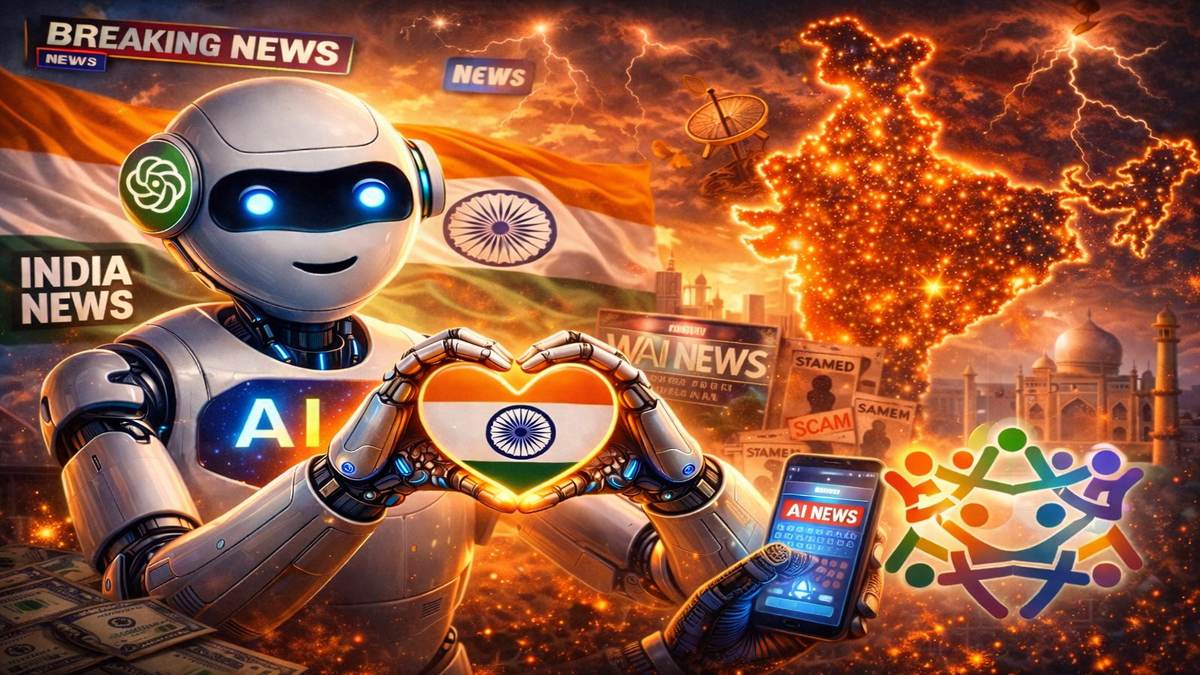
India is quietly becoming one of the world’s largest AI user bases.
From students asking homework questions on ChatGPT to small businesses automating customer service on WhatsApp, AI tools are rapidly embedding themselves into everyday life. The country is now the second-largest user base—after the US—of platforms like OpenAI’s ChatGPT and Anthropic’s Claude.
But here’s the uncomfortable question no one wants to ask out loud: Is India building an AI superpower—or simply training Silicon Valley’s models for free? Because right now, it looks a lot like the latter.
The Three Pillars of AI Power
To understand where India stands, let’s break AI down to its core building blocks:
- Talent
- Compute (high-end chips, data centers, infrastructure)
- Data
India has one of the largest pools of engineers in the world. Every year, thousands of developers graduate from top institutions. Indian-origin engineers also power research labs in the US, Europe, and beyond.
But here’s the gap: foundational AI research at scale remains limited. India produces strong coders—but not yet enough large-scale AI scientists building cutting-edge models domestically.
Then there’s compute.
Advanced AI systems require enormous amounts of GPU power. The kind supplied by Nvidia’s most advanced chips—often in short supply and heavily concentrated in US-based tech giants. Indian universities and public labs simply don’t have that level of infrastructure at scale.
So if talent is partial and compute is constrained, what does India have in abundance?
Data.
And that may be the most valuable asset of all.
The Real Asset: A Billion Digital Lives
India has roughly a billion people online. It is mobile-first, digitally connected, and constantly generating data:
- Messages in dozens of languages
- Voice notes and call recordings
- UPI payment histories
- Social media posts
- Customer service chats
- App usage behaviors
Every interaction becomes training material for AI systems—directly or indirectly.
AI improves through exposure to real human behavior. And India, with its linguistic diversity and scale, provides an enormous stream of that input.
Yet while India ranks second in user volume for platforms like ChatGPT, it accounts for only a fraction of revenue compared to the US.
That’s revealing.
It suggests the market’s value lies less in monetization—and more in training.
Free trials, discounted access, student outreach programs: they’re not just generous gestures. They’re part of a strategic expansion into a high-data-density environment.
This dynamic raises a risk: India exporting raw data the way it once exported raw materials—only to buy back refined products at a premium.
The Language Problem No One Can Ignore
India has more than 20 official languages and dozens more widely spoken dialects.
AI models trained primarily on English-language data often struggle with:
- Regional idioms
- Cultural references
- Legal terminology in local contexts
- Rural dialect variations
If AI tools are to function reliably in Indian classrooms, hospitals, courts, and government offices, they must deeply understand local languages and social nuance.
Prime Minister Narendra Modi has emphasized democratizing AI—ensuring it serves farmers, small-business owners, and rural communities, not just urban English speakers.
But democratization requires representation in training data.
If foreign AI systems become fluent in Indian languages first—using Indian user data—while domestic ecosystems lag behind, the value capture flows outward.
India risks becoming the world’s largest unpaid labeling workforce.
The Strategic Stakes: Control vs Extraction
This isn’t about blocking global AI companies. That would be counterproductive.
The real issue is control over value.
Who controls:
- The data pipelines?
- The datasets?
- The research infrastructure?
- The economic upside?
Right now, foreign tech giants gain access to Indian user interactions, refine their systems, and monetize them globally.
India absorbs:
- Potential job displacement
- Social impacts of automation
- Language bias errors
- Regulatory challenges
Without retaining proportional economic benefits.
That imbalance mirrors older industrial patterns—extract, refine elsewhere, resell.
AI just happens to use data instead of minerals.
The Opportunity: Turning Data into Infrastructure
Here’s where India has a real chance to lead—not just catch up.
Instead of walling off data, the government can:
- Treat key datasets as strategic infrastructure
- Develop secure public data trusts
- Create revenue-sharing frameworks
- Demand compute and training partnerships in return
For example:
Healthcare data in India is vast—but fragmented across hospital systems. Properly anonymized and securely structured, it could enable AI diagnostics tailored to Indian populations.
The same applies to:
- Agriculture yield patterns
- Financial inclusion data
- Multilingual speech corpora
- Legal judgments across regional courts
Done correctly, these datasets become public goods—foundational layers for domestic startups, researchers, and innovators.
But building them requires serious policy focus and institutional coordination.
It’s unglamorous work. No flashy product launch. No viral demo.
Just infrastructure.
Startups Are Trying—But It’s Not Enough
Some startups and nonprofit coalitions are already attempting to crowdsource or create Indian-language datasets.
These efforts are critical, but they can’t carry the burden alone.
Data-labeling industries have long faced accusations of exploitative labor practices globally. If India becomes a major contributor to AI data pipelines, it must also set ethical standards for how that labor is structured and compensated.
Otherwise, it risks repeating a familiar pattern: exporting human effort cheaply while importing high-margin finished products.
Building a domestic AI ecosystem requires:
- Public compute commitments
- Access to advanced GPUs
- Research funding for foundational models
- Transparent collaboration frameworks with foreign firms
Token partnerships won’t cut it.
The Compute Gap
Even with the right data policies, India must address compute access.
Advanced AI development depends on high-end chips and large-scale data centers.
Without access to cutting-edge hardware, domestic AI firms remain downstream integrators rather than foundational innovators.
If India negotiates partnerships with global AI firms, those deals should include:
- Local data center investments
- Chip access agreements
- Research exchange programs
- Open evaluation transparency in Indian contexts
Data shouldn’t flow outward without reciprocal capacity-building inward.
Transparency: The Missing Piece
Another critical lever is transparency.
Policymakers can require AI companies operating at scale in India to disclose:
- What types of data trained their models
- Whether Indian-language datasets were included
- How bias and harm were evaluated in local contexts
Transparency won’t solve everything—but it shifts the conversation from blind adoption to informed governance.
If Indian user data is shaping global AI systems, the public deserves visibility into that process.
Leading the Global South
India has a unique opportunity to shape AI policy for emerging economies.
Many countries across Africa, Southeast Asia, and Latin America face similar challenges:
- Massive data generation
- Limited compute
- Heavy reliance on foreign AI platforms
If India establishes equitable data governance norms, it can become a model for the Global South—balancing openness with strategic leverage.
That influence may ultimately matter more than building the biggest foundation model.
Because power in AI isn’t only about model size.
It’s about:
- Standards
- Governance
- Value capture
- Capacity building
The Fork in the Road
India stands at a crossroads.
Path one: continue as a vast open mine of behavioral data—fueling global AI systems while domestic ecosystems lag.
Path two: recognize data as strategic infrastructure, negotiate capacity-building partnerships, and build research depth alongside scale.
The difference between those paths determines whether India becomes an AI superpower—or simply the world’s most populous training dataset.
The boom has already begun.
The real question now isn’t whether India will shape AI.
It’s whether it will shape it on its own terms.
⚠️ Disclaimer:
This article is for informational and analytical purposes only and does not constitute policy, legal, or investment advice. Readers should conduct their own research and consult appropriate experts before making decisions related to AI strategy or regulation.


